Hi everyone,
I am very new to the SCT and I have a question about handling longitudinal spinal cord MRI data. Specifically, I have a cohort of multiple sclerosis patients with brain 3D-T1 scans (acquired at baseline, 6 months and 2 years) with a field of view extending down to C3.
My goal is to quantify SC volume loss over 2 years, and I wanted to ask what you consider the most reliable/state-of-the-art approach for assessing it.
In particular, would you recommend simply calculating the percentage change in MUCCA (i.e., [(MUCCA at 2 years − MUCCA at baseline) / MUCCA at baseline] × 100), or is there a more robust longitudinal framework available, analogous to the halfway-space approach commonly used for brain atrophy measurement (to reduce interpolation bias and improve sensitivity to change)?
Thank you very much for your help!
Dear @Virginia,
Thank you so much for your post! I appreciate the detail and context you’ve provided here.
My goal is to quantify SC volume loss over 2 years, and I wanted to ask what you consider the most reliable/state-of-the-art approach for assessing it. […] is there a more robust longitudinal framework available […]?
As you allude to, longitudinal analysis is an open research topic with regards to how to best apply SCT, and so I’m not sure if I have a conclusive recommendation right away.
That said, our lab has started some initial discussions with respect to addressing bias in longitudinal analysis:
- Open project ideas
- In-progress projects
But I’m realizing now that these topics are slightly tangential vs. your original question:
In particular, would you recommend simply calculating the percentage change in MUCCA (i.e., [(MUCCA at 2 years − MUCCA at baseline) / MUCCA at baseline] × 100)?
I’m not sure I can answer this myself. But, the author of the sc-ms-lesion-tracking project will be returning shortly after summer vacation. I am happy to let him know about this forum post so that we can follow up. 
Kind regards,
Joshua
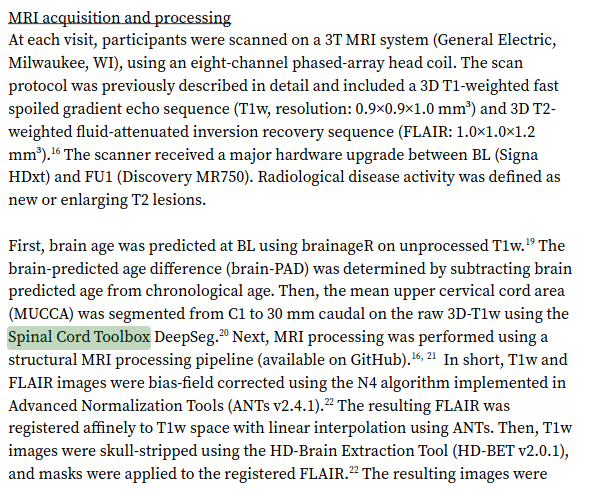
Oh wow! By pure coincidence, just today we received a notification in our citation-tracking channel for a newly-published study featuring SCT for longitudinal analysis:
I have not yet had a chance to read this in detail, but I thought I would share as the timing seemed appropriate.
Kind regards,
Joshua
Another happy coincidence: A recent PhD thesis chapter (and submitted manuscript?) that focuses on MUCCA computation in longitudinal analysis:

For the sake of tracking unresolved forum posts, I’m going to mark this as resolved for now, but if you have further questions please don’t hesitate to post further and I can mark this post as ‘open’ once more, and we will be happy to help in whichever way we can.